
Introduction
App Reviews play a very important role in today’s digital world. Every day, millions of people download mobile and web applications to solve problems, save time, learn new skills, or enjoy entertainment. Before installing any app, most users first check Reviews to see what others are saying. These reviews help users decide whether an app is worth their time, money, and device space. Because of this, App Reviews have become a powerful tool for both users and developers.
For beginners, App Reviews offer simple guidance and real-life experiences shared by other users. They explain how an app works, what features are useful, and what problems may appear after use. For intermediate users, App Reviews provide deeper insights, comparisons, and performance details. Businesses and developers also rely heavily on App Reviews to improve their products and build trust with new users.
In simple words, App Reviews act like honest feedback shared publicly. They influence app rankings, downloads, and long-term success. A well-written review can guide thousands of people, while poor or fake reviews can damage an app’s reputation. That is why understanding App Reviews is important for everyone involved in the app ecosystem.
This guide is written in simple English with a natural tone. It is designed to help beginners and intermediate readers clearly understand App Reviews, their importance, how to write them properly, and how to avoid common mistakes. By the end, you will have complete knowledge and confidence about App Reviews and their real-world impact.
What is App Reviews?
App Reviews are written opinions and ratings shared by users after using an application. These reviews usually appear on app stores or platforms where apps are listed. They include feedback about performance, design, features, ease of use, and overall experience.
Most App Reviews include two main parts. The first part is a rating, often shown in stars. The second part is written feedback where users explain their experience. Some reviews are short, while others are detailed and descriptive.
App Reviews can be positive, negative, or neutral. Positive reviews highlight useful features and smooth performance. Negative reviews point out bugs, crashes, or poor support. Neutral reviews usually share both good and bad points.
These reviews are not only helpful for users but also for developers. Developers read App Reviews to understand user needs and fix problems. In this way, App Reviews help apps grow and improve over time.
Why is App Reviews Important?

App Reviews are important because they influence decisions. Most users trust reviews more than advertisements. When many people share similar experiences, new users feel confident in their choices.
For app developers, App Reviews act as free feedback. They show what users like and what needs improvement. Good reviews can increase app downloads and visibility.
From a business point of view, App Reviews affect app store rankings. Apps with better ratings and frequent reviews often appear higher in search results. This leads to more organic downloads.
App Reviews also build trust. When users see honest opinions, they feel safer installing an app. Without reviews, users may hesitate or choose a competitor instead.
Detailed Step-by-Step Guide
Step 1: Use the App Properly
Before writing App Reviews, it is important to use the app for some time. Explore its main features and understand its purpose. This helps you give honest and useful feedback.
Step 2: Identify Key Features
Focus on important features such as speed, design, usability, and performance. Mention what works well and what does not. This makes App Reviews more helpful.
Step 3: Be Honest and Clear
Always write honest App Reviews. Avoid exaggeration. Use simple words and clear sentences so everyone can understand your experience.
Step 4: Mention Problems and Solutions
If you face issues, explain them clearly. Also mention if customer support helped or if updates fixed the problem. Balanced App Reviews are more trusted.
Step 5: Give a Fair Rating
Choose a rating that matches your experience. Do not give very high or very low ratings without strong reasons.
Benefits of App Reviews
- Help users make informed decisions
- Improve app quality through feedback
- Increase trust and credibility
- Boost app visibility in stores
- Encourage developers to fix issues
- Support fair competition
Disadvantages / Risks
- Fake or paid reviews can mislead users
- Emotional reviews may lack facts
- Negative reviews can harm small developers
- Review bombing can damage reputation
- Some reviews may be outdated
Common Mistakes to Avoid
Many people make mistakes while writing App Reviews. One common mistake is reviewing without using the app properly. Another mistake is writing very short reviews with no useful details.
Using offensive language is also a big mistake. It reduces credibility and may get the review removed. Copying others’ App Reviews is another problem and should always be avoided.
Avoid focusing on personal issues unrelated to the app. Also, do not update ratings without explaining the reason. Clear and fair App Reviews are always more valuable.
FAQs
What makes App Reviews trustworthy?
Trustworthy App Reviews are detailed, balanced, and written after real use. They explain both pros and cons clearly.
Can App Reviews affect app rankings?
Yes, App Reviews strongly affect rankings. Apps with better ratings and frequent reviews usually rank higher.
Are all App Reviews real?
Not always. Some reviews may be fake or paid. Reading multiple reviews helps identify genuine feedback.
How long should App Reviews be?
There is no fixed length. However, clear and informative App Reviews are more useful than very short ones.
Should developers reply to App Reviews?
Yes, replying shows care and professionalism. It also helps build trust with users.
Can App Reviews improve app quality?
Yes, developers use App Reviews to identify issues and improve features based on user needs.
Expert Tips & Bonus Points
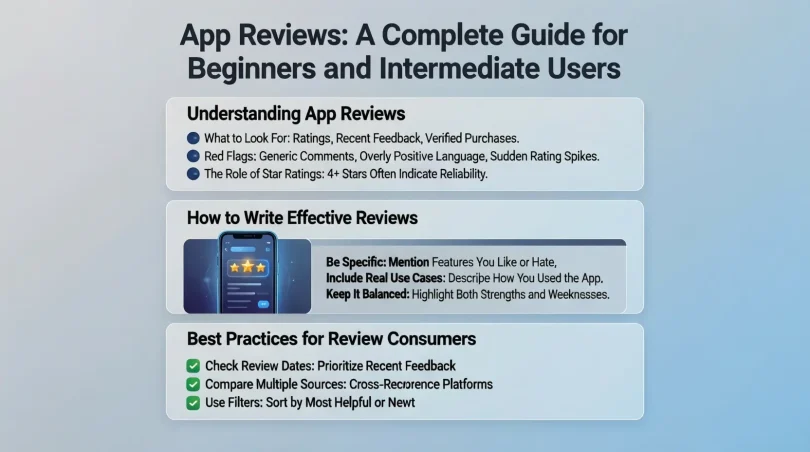
Always read recent App Reviews because updates can change performance. Compare multiple reviews instead of trusting one opinion. Look for patterns in feedback, as repeated issues are usually real problems.
When writing App Reviews, think about helping others. Mention device type or version if relevant. Use polite language even when sharing negative experiences. This increases the impact of your review.
Conclusion
App Reviews are a powerful part of the modern app ecosystem. They guide users, support developers, and influence the success of applications. For beginners, App Reviews provide clarity and confidence before downloading an app. For intermediate users, they offer deeper insights and comparisons that save time and effort.
Writing honest and detailed App Reviews benefits everyone. Users get better information, and developers receive valuable feedback. However, it is important to avoid fake, emotional, or careless reviews that reduce trust.
By understanding how App Reviews work, why they matter, and how to write them correctly, you become a responsible digital user. Whether you are reading or writing App Reviews, always focus on honesty, clarity, and usefulness. In the long run, quality App Reviews help create better apps, stronger trust, and a healthier digital environment for all users.