
Introduction
Learning something new can feel confusing, especially when the topic looks complex at first glance. Many guides either oversimplify important details or explain things in a way that feels too technical. That is where an Advanced How-To approach becomes useful. It bridges the gap between basic knowledge and practical, real-world skills. Instead of guessing or copying others, you learn how to do things properly, step by step.
An Advanced How-To guide is designed to help beginners grow confidently while also giving intermediate learners deeper clarity. It focuses on clear explanations, logical steps, and helpful examples. This way, you do not just follow instructions blindly. You understand why each step matters and how it fits into the bigger picture.
In today’s fast-moving digital and professional world, knowing “what” is not enough. You must also know “how” and “why.” An Advanced How-To method helps you build that understanding. It reduces mistakes, saves time, and improves results in almost any task, whether it is technical, creative, or process-based.
This article is written in simple English and follows a clean structure. It avoids confusing language and focuses on practical value. By the end, you will clearly understand what an Advanced How-To is, why it matters, and how to apply it effectively. Most importantly, you will feel confident using this approach in your own learning and work.
What is Advanced How-To?
An Advanced How-To is a detailed instructional approach that goes beyond basic tips. It explains not only the steps involved in a task but also the logic, best practices, and common challenges behind those steps. The goal is to help learners gain deeper control and understanding.
Unlike beginner guides, an Advanced How-To does not stop at surface-level instructions. It covers preparation, execution, and improvement. This makes it useful for people who already know the basics and want to move forward.
Key characteristics of an Advanced How-To include clarity, structure, and depth. Each step is explained in a logical order so readers can follow easily. At the same time, the guide avoids unnecessary jargon to remain accessible.
Another important feature is adaptability. An Advanced How-To teaches principles that can be applied in different situations. Instead of memorizing steps, you learn how to adjust based on your needs.
Overall, an Advanced How-To is about learning smarter. It focuses on building strong foundations while adding advanced insights that improve performance and confidence.
Why is Advanced How-To Important?

The importance of an Advanced How-To lies in its ability to turn knowledge into action. Many people struggle because they know the theory but cannot apply it correctly. This approach solves that problem.
First, it reduces confusion. Clear steps and explanations remove guesswork. You know exactly what to do and when to do it.
Second, it saves time. Instead of trial and error, you follow a proven process. This leads to faster results and fewer mistakes.
Third, it builds confidence. When you understand the reasoning behind each step, you feel more in control. This confidence helps you tackle more complex tasks.
Fourth, an Advanced How-To improves long-term learning. You remember concepts better because you understand them deeply. This makes it easier to apply the same knowledge in new situations.
Finally, it encourages professional growth. Whether you are learning a skill for work or personal development, this method helps you stand out by delivering better outcomes.
Detailed Step-by-Step Guide
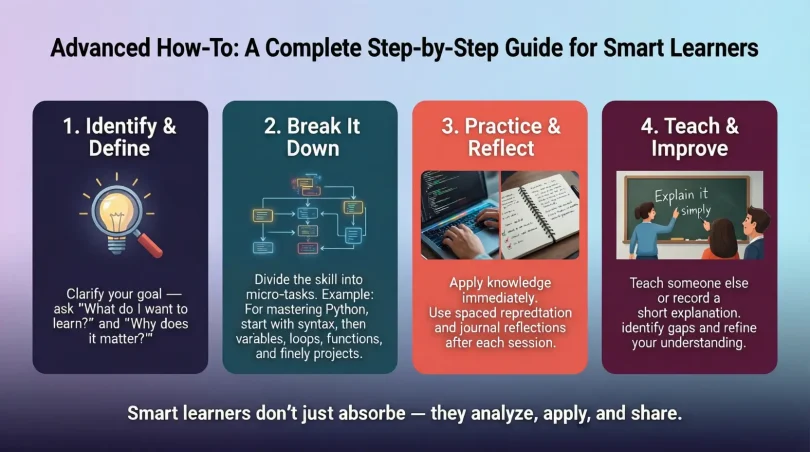
Step 1: Define Your Goal Clearly
Every Advanced How-To process starts with a clear goal. Without a defined outcome, even the best instructions can fail. Take time to understand what you want to achieve.
Write your goal in simple words. Make sure it is specific and measurable. A clear goal helps you stay focused and choose the right steps.
Step 2: Understand the Basics First
Before moving into advanced steps, review the basics. This ensures you are not missing essential knowledge. Skipping this step often leads to confusion later.
Check your understanding of key terms and concepts. If something feels unclear, address it early. A strong base makes advanced learning easier.
Step 3: Break the Task into Sections
Large tasks can feel overwhelming. An Advanced How-To approach breaks them into smaller sections. Each section focuses on one part of the process.
This structure makes learning manageable. It also helps you track progress and identify where improvements are needed.
Step 4: Follow a Logical Sequence
Order matters. Steps should be followed in a logical sequence to avoid errors. Do not rush or skip steps, even if they seem simple.
A logical flow ensures that each action builds on the previous one. This leads to smoother execution and better results.
Step 5: Apply Practical Examples
Examples turn theory into reality. When learning through an Advanced How-To, always connect steps with real-life situations.
Examples help you see how a concept works in practice. They also make it easier to remember and apply later.
Step 6: Test and Adjust
Testing is a key part of any advanced process. After applying the steps, review your results. Identify what worked and what did not.
Make adjustments based on your findings. This flexibility is a major strength of the Advanced How-To method.
Step 7: Document Your Process
Writing down what you learn helps reinforce knowledge. Keep notes on steps, challenges, and solutions.
Documentation also makes it easier to repeat the process in the future or share it with others.
Step 8: Improve Through Feedback
Feedback helps you grow. Ask others for input or review your own work critically.
Use feedback to refine your approach. Over time, this leads to mastery and consistent improvement.
Benefits of Advanced How-To
- Provides clear and structured learning
- Reduces mistakes and confusion
- Saves time through proven steps
- Builds confidence and independence
- Improves long-term understanding
- Encourages practical application
- Supports continuous improvement
Disadvantages / Risks
- Can feel detailed for absolute beginners
- Requires time and focus to follow properly
- Over-analysis may slow quick tasks
- Needs regular updates to stay relevant
- Not suitable for tasks needing instant action
Common Mistakes to Avoid
One common mistake is skipping the basics. Many learners jump into advanced steps without a strong foundation. This often leads to errors and frustration.
Another mistake is rushing the process. An Advanced How-To works best when followed patiently. Speed should not replace understanding.
Ignoring feedback is also a problem. Without review and adjustment, improvement becomes difficult.
Some people rely too much on instructions and stop thinking critically. Remember, the goal is understanding, not blind following.
Finally, failing to practice regularly can limit progress. Consistent use of the method leads to better results.
FAQs
What makes an Advanced How-To different from a basic guide?
A basic guide focuses on simple steps. An Advanced How-To explains reasoning, best practices, and improvements for deeper learning.
Is an Advanced How-To suitable for beginners?
Yes, beginners can use it if they are willing to learn patiently. The clear structure helps build understanding gradually.
How long does it take to see results?
Results depend on the task and effort. However, most people notice improved clarity and confidence early in the process.
Can this method be applied to any skill?
Yes, the Advanced How-To approach works for technical, creative, and professional skills.
Do I need special tools to follow an Advanced How-To?
In most cases, no. The focus is on understanding and process rather than tools.
How can I improve my Advanced How-To skills?
Practice regularly, seek feedback, and review your process. Continuous learning leads to mastery.
Expert Tips & Bonus Points
Start with small projects to build confidence. Gradually move to complex tasks as your understanding improves.
Use visuals or diagrams if possible. They help clarify complex steps.
Teach others what you learn. Teaching reinforces your own knowledge.
Stay flexible. Adapt steps to fit your situation instead of following them rigidly.
Review your progress regularly. Reflection helps identify strengths and areas for improvement.
Conclusion
An Advanced How-To approach is more than just a set of instructions. It is a smart way to learn, apply, and improve skills with confidence. By focusing on clarity, structure, and understanding, this method helps both beginners and intermediate learners move forward effectively.
When you use an Advanced How-To, you reduce confusion and avoid common mistakes. You gain deeper insight into how things work and why certain steps matter. This understanding makes learning more meaningful and long-lasting.
The key to success is patience and consistency. Follow each step carefully, test your results, and make improvements based on feedback. Over time, this process becomes natural and efficient.
In a world where skills matter more than ever, adopting an Advanced How-To mindset can set you apart. It empowers you to learn smarter, work better, and achieve stronger results. With regular practice and thoughtful application, this approach can become one of your most valuable learning tools.