
Introduction
Beginner Guides are designed to help people start learning something new without feeling confused or overwhelmed. When you begin a new skill, topic, or field, everything can feel difficult at first. There are new terms, unfamiliar steps, and many choices that can slow you down. Beginner Guides solve this problem by breaking complex ideas into simple and clear explanations. They focus on helping readers move forward with confidence, one step at a time.
In today’s fast-moving digital world, people want quick and clear learning paths. Beginner Guides provide exactly that. They are written in easy language, use practical examples, and follow a logical structure. Instead of assuming prior knowledge, they start from the basics. This makes them perfect for students, professionals, and self-learners who want to grow their skills.
Beginner Guides are also useful for intermediate learners. Even if you already know a little about a topic, a well-written guide can help you fix gaps in your understanding. It can refresh your basics and improve your overall knowledge.
This article is a complete Beginner Guides resource. It explains what Guides are, why they are important, how to use them step by step, and how to avoid common mistakes. By the end, you will clearly understand how Beginner Guides can help you learn faster, smarter, and with more confidence.
What is Beginner Guides?
Beginner Guides are learning resources created especially for people who are new to a topic. They explain concepts in a simple and structured way so readers can understand without stress. The main goal of Beginner Guides is clarity. They avoid complex language and focus on practical learning.
A Beginner Guide usually starts with basic definitions. It then moves step by step toward more detailed explanations. Each section builds on the previous one. This makes learning smooth and logical. Readers do not feel lost because every step is clearly explained.
Beginner Guides can be used in many areas. They are common in technology, education, business, and personal development. For example, a beginner guide to computers explains basic terms before moving to advanced tasks. A beginner guide to writing starts with sentence structure before teaching full articles.
Another important feature of Beginner Guides is their friendly tone. They are written to encourage learners. Mistakes are treated as part of the learning process. This approach builds confidence and motivation.
In simple words, Beginner Guides are learning roadmaps. They show you where to start, what to learn next, and how to improve over time.
Why is Beginner Guides Important?

Beginner Guides are important because they remove fear from learning. Many people want to learn new skills but feel scared of complexity. Beginner Guides make learning feel possible and manageable.
One key reason Beginner Guides matter is accessibility. Anyone can use them, regardless of background or education level. This opens learning opportunities for more people.
Beginner Guides also save time. Instead of searching through random information, learners get a clear path. This reduces confusion and helps them focus on what truly matters.
Another benefit is consistency. Beginner Guides follow a structured format. This helps learners stay organized and track their progress easily.
Beginner Guides also improve retention. When information is presented in small, clear steps, people remember it better. This leads to stronger long-term understanding.
Finally, Beginner Guides build confidence. When learners understand the basics clearly, they feel motivated to continue learning. This confidence is the foundation for growth and success.
Detailed Step-by-Step Guide
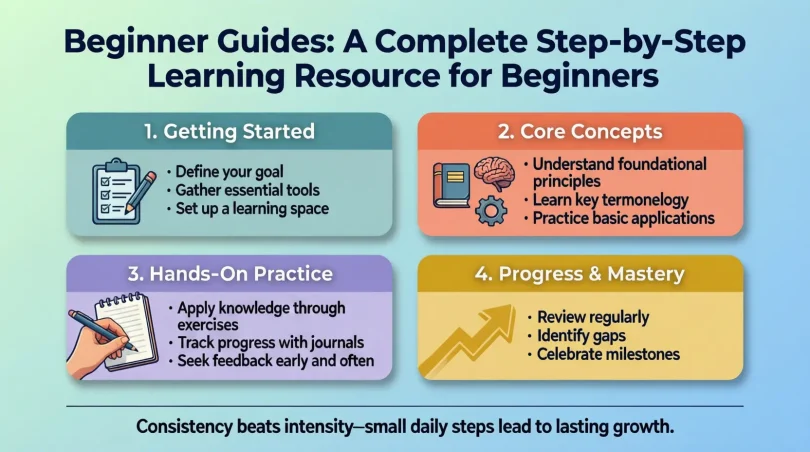
Step 1: Choose the Right Beginner Guide
Start by selecting a Beginner Guide that matches your level. Make sure it is truly designed for beginners. Check the language, structure, and examples used.
Step 2: Understand the Learning Goals
Every good Beginner Guide explains what you will learn. Read the introduction carefully. Knowing the goals helps you stay focused and motivated.
Step 3: Learn the Basic Terms
Most Beginner Guides start with definitions. Take your time with this part. Understanding basic terms makes the rest of the guide easier.
Step 4: Follow the Steps in Order
Do not skip sections. Beginner Guides are written in a sequence. Each step builds on the previous one. Skipping can create confusion later.
Step 5: Practice What You Learn
Apply the concepts immediately. Practice helps turn knowledge into skill. Beginner Guides often include examples for this reason.
Step 6: Take Notes and Summaries
Writing short notes helps reinforce learning. Summaries make revision easier and faster.
Step 7: Review and Repeat
Go back to difficult sections. Repetition improves understanding and confidence.
Step 8: Move to Intermediate Content
Once you finish a Beginner Guide, move to more advanced material. Your strong foundation will make learning easier.
Benefits of Beginner Guides
- Easy to understand for all learners
- Clear step-by-step structure
- Reduces confusion and stress
- Builds strong basic knowledge
- Saves time and effort
- Increases confidence
- Encourages self-learning
- Suitable for many topics
Disadvantages / Risks
- May feel too basic for advanced learners
- Some guides oversimplify topics
- Quality varies between sources
- Limited depth in complex subjects
- Overreliance can slow independent thinking
Common Mistakes to Avoid
One common mistake is rushing through the guide. Beginner Guides are meant to be read slowly. Skimming can reduce understanding.
Another mistake is skipping practice. Reading without applying knowledge limits progress.
Some learners use multiple Beginner Guides at once. This can cause confusion. Stick to one guide at a time.
Ignoring basics is also a mistake. Strong foundations are essential for growth.
Finally, many learners stop after finishing a Beginner Guide. Learning should continue beyond the basics.
FAQs
What are Beginner Guides used for?
Beginner Guides are used to learn new skills or topics from scratch. They provide simple explanations and structured steps.
Are Beginner Guides only for beginners?
No, intermediate learners can also benefit. They help refresh basics and fill knowledge gaps.
How long should a Beginner Guide be?
There is no fixed length. A good Beginner Guide covers all basics clearly without unnecessary details.
Can Beginner Guides be self-taught?
Yes, Beginner Guides are perfect for self-learning. They are designed for independent learners.
Do Beginner Guides guarantee mastery?
Beginner Guides build foundations. Mastery requires practice, experience, and advanced learning.
How do I know if a Beginner Guide is good?
A good Beginner Guide uses simple language, clear steps, and practical examples.
Expert Tips & Bonus Points
Choose Beginner Guides written by experienced educators. Quality matters.
Set realistic learning goals. Do not rush the process.
Combine reading with practice for better results.
Review content regularly to strengthen memory.
After finishing a Beginner Guide, challenge yourself with small projects.
Stay patient and consistent. Learning is a journey, not a race.
Conclusion
Beginner Guides play a powerful role in learning and personal growth. They make complex topics simple and approachable. By focusing on clear explanations and step-by-step learning, Beginner Guides help learners build strong foundations. This foundation is essential for long-term success in any field.
Whether you are learning a new skill, starting a career, or improving existing knowledge, Beginner Guides provide the right starting point. They reduce fear, save time, and improve understanding. Most importantly, they build confidence. When learners feel confident, they are more likely to continue learning and improving.
To get the best results, choose high-quality Beginner Guides, follow them patiently, and practice regularly. Avoid common mistakes and move forward step by step. Learning does not need to be stressful or confusing. With the right Beginner Guides, it becomes clear, structured, and rewarding.
In the end, Beginner Guides are not just learning tools. They are supportive companions that guide you from uncertainty to understanding. When used correctly, they open doors to knowledge, growth, and new opportunities.