
Introduction
Troubleshooting Guides are essential tools for anyone who uses technology in daily life. From computers and mobile phones to software applications and internet connections, problems can appear at any time. For beginners and intermediate users, these problems often feel confusing and stressful. However, with the right approach, most issues can be identified and fixed without expert help.
Troubleshooting Guides provide a clear and structured way to find problems and solve them efficiently. Instead of guessing or randomly trying solutions, these guides help users follow logical steps. As a result, time is saved, frustration is reduced, and confidence grows. Whether you are dealing with slow system performance, error messages, or devices not working properly, troubleshooting guides make the process easier.
In today’s digital world, knowing how to troubleshoot basic issues is a valuable skill. Many problems are minor but look serious because users do not understand the cause. With proper troubleshooting guides, users can learn how to analyze symptoms, identify root causes, and apply the correct fixes.
This article explains troubleshooting guides in simple English. It is written for beginners and intermediate readers who want practical knowledge. By the end, you will understand what troubleshooting guides are, why they matter, how to use them step by step, and how to avoid common mistakes. Most importantly, you will gain confidence in solving everyday technical problems on your own.
What Are Troubleshooting Guides?
Troubleshooting Guides are structured instructions designed to help identify and fix problems. They follow a logical sequence that starts with understanding the issue and ends with a solution.
These guides are commonly used in technology, including computers, software, networks, and electronic devices. However, the same principles apply in many other fields as well.
A good troubleshooting guide focuses on:
- Identifying the problem clearly
- Understanding possible causes
- Testing solutions step by step
- Confirming that the issue is resolved
Troubleshooting guides are written in a way that users can follow easily. They reduce guesswork and help users avoid unnecessary actions that may cause more problems.
Why Are Troubleshooting Guides Important?

Troubleshooting Guides play a critical role in problem-solving. Without them, users often rely on trial and error, which can waste time and damage systems.
Key reasons why troubleshooting guides are important include:
First, they save time by offering a clear path to solutions. Instead of searching randomly, users follow proven steps.
Second, they reduce costs. Many issues can be fixed without professional help when proper troubleshooting guides are used.
Third, they improve learning. Users understand how systems work by identifying causes and effects.
Finally, they build confidence. When users solve problems themselves, they become more independent and skilled.
Because of these benefits, troubleshooting guides are widely used by professionals and beginners alike.
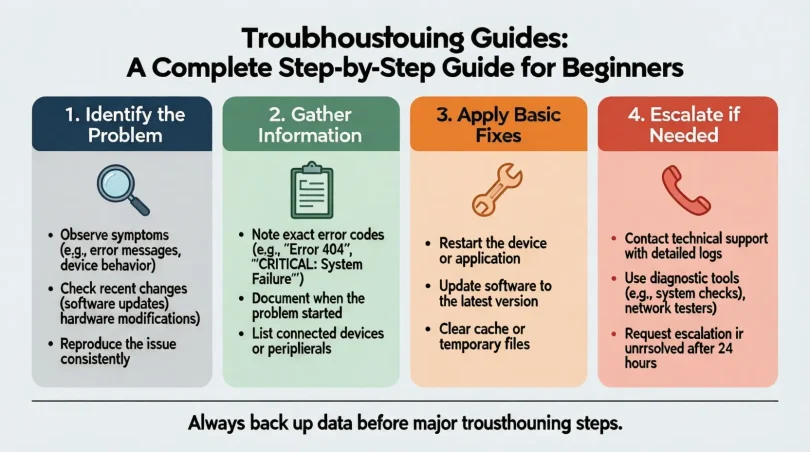
Detailed Step-by-Step Guide
Step 1: Identify the Problem Clearly
The first step in troubleshooting guides is understanding the exact problem. Observe symptoms carefully.
Ask questions such as:
- When did the problem start?
- What changed recently?
- Does the issue happen all the time or sometimes?
Clear problem identification prevents confusion later.
Step 2: Check Basic Causes First
Many issues have simple causes. Troubleshooting guides always recommend starting with basics.
Examples include:
- Loose cables
- Power issues
- Incorrect settings
- Software not updated
Fixing basic problems often solves the issue quickly.
Step 3: Reproduce the Issue
Try to recreate the problem in a controlled way. This helps confirm the issue and understand triggers.
Reproducing the issue ensures that you are solving the correct problem.
Step 4: Research Possible Causes
Once basics are checked, list possible reasons for the problem. Troubleshooting guides encourage logical thinking here.
Common causes may include:
- Software conflicts
- Corrupted files
- Hardware limitations
- Network issues
Step 5: Apply Solutions One by One
Apply fixes in a step-by-step manner. Never try multiple solutions at once.
After each step:
- Test the system
- Observe changes
- Note results
This method ensures accuracy.
Step 6: Verify the Solution
Once the problem seems fixed, confirm it completely.
Use the system normally for some time to ensure the issue does not return.
Step 7: Document the Fix
Good troubleshooting guides always recommend documenting solutions.
This helps in future problems and saves time if the issue appears again.
Benefits of Troubleshooting Guides
- Save time by offering structured solutions
- Reduce dependency on technical support
- Improve understanding of systems
- Prevent unnecessary repairs
- Increase user confidence
- Encourage logical thinking
- Minimize downtime
Disadvantages / Risks
- Incorrect diagnosis may cause delays
- Poorly written guides can confuse users
- Skipping steps may worsen problems
- Overconfidence may lead to risky actions
- Some issues still require professional help
Common Mistakes to Avoid
One common mistake is skipping basic checks. Many users ignore simple causes and jump to advanced steps.
Another mistake is applying multiple fixes at once. This makes it difficult to know what actually worked.
Ignoring error messages is also a problem. Error messages provide valuable clues in troubleshooting guides.
Lastly, not documenting solutions can lead to repeated mistakes in the future.
FAQs
What are troubleshooting guides used for?
Troubleshooting guides are used to identify, analyze, and fix problems in a structured way. They help users solve issues efficiently.
Are troubleshooting guides only for technical problems?
No, troubleshooting guides can be used in many fields. However, they are most commonly used for technical and system-related issues.
Can beginners use troubleshooting guides easily?
Yes, troubleshooting guides are designed for beginners. They use step-by-step instructions that are easy to follow.
Do troubleshooting guides replace technical support?
They do not fully replace professionals. However, they reduce the need for support in many simple and medium-level issues.
Why is step-by-step troubleshooting important?
Step-by-step troubleshooting prevents confusion, reduces risk, and helps identify the exact cause of the problem.
How often should troubleshooting guides be updated?
They should be updated regularly to match new systems, software updates, and technology changes.
Expert Tips & Bonus Points
Always stay calm when troubleshooting. Stress often leads to mistakes.
Read error messages carefully before searching for solutions.
Create your own troubleshooting checklist for common issues.
Learn from past problems and document solutions.
Practice logical thinking instead of guessing.
Conclusion
Troubleshooting Guides are powerful tools that simplify problem-solving for beginners and intermediate users. They provide a structured approach that turns confusing issues into manageable tasks. By following clear steps, users can identify problems, understand causes, and apply effective solutions without unnecessary stress.
In modern digital life, technical problems are unavoidable. However, the way we handle them makes a big difference. Troubleshooting guides encourage logical thinking, patience, and accuracy. Instead of relying on guesswork or external help, users become more independent and confident.
While troubleshooting guides are not perfect and cannot fix every problem, they handle most common issues efficiently. The key is to follow steps carefully, avoid shortcuts, and document successful solutions.
By learning and applying troubleshooting guides, you develop a valuable skill that saves time, money, and effort. With practice, troubleshooting becomes easier, faster, and more reliable. This makes troubleshooting guides an essential resource for anyone who wants better control over their technology and systems.